
Think about your favorite character. Is he a superhero? Or is he a narcissistic philanderer in ad sales? Do you root for the man cooking the meth or the DEA agent trying to stop him? Do you root for the savior or the criminal? You’ve probably seen and heard about the “Joker” Movie that broke Worldwide B.O. record for R-Rated film with $788 million +. The movie talks about the crazed Batman nemesis and sheds the light on his origins and history. While in the movie “Batman”, Batman was himself the so-called hero, while in the “Joker” the movie, joker tended to be the hero that had a monster within himself.
Every hero needs a to confront a monster or villain to be the protagonist he is. A hero can also have a monster within himself, and battle a psychological and emotional war, or can be challenged materially and physically.
In this blog, we will introduce digital humanities tools such as CliC and Voyant in reference to our topic “Heroes vs Monsters”. We’re going to focus on how the concept of heroes and monsters have evolved through time since Greek mythology to our modern days and how that evolution has tremendously affected their appearances. First, we will be introducing you to the world of CLiC and Voyant in addition to the corpus that we used.
The corpus created for CLiC and Voyant Tools is made up from “The Odyssey” (8Th Century BCE), one of two major ancient Greek epic poems written by Homer, and the Greek tragedy by Sophocles “Oedipus Rex” (5th Century BCE) and “The Story of Robin Hood and His Merrie Men” whichwas written by Howard Pile (1952). We extracted these texts, in their plain form, from “Gutunberg.org”.
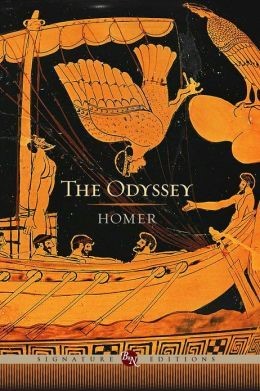
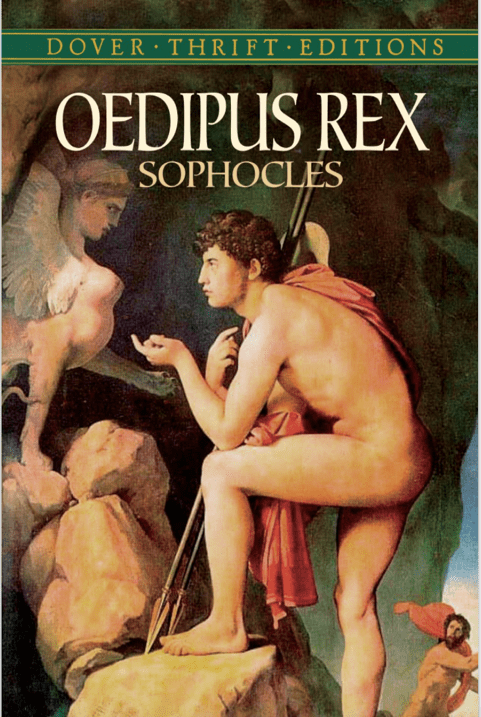
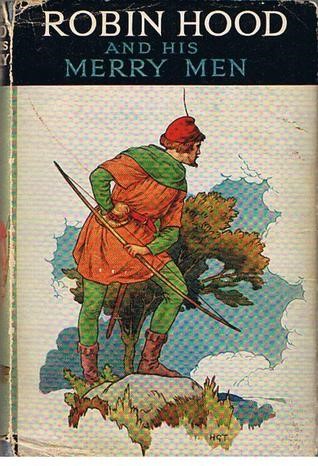
These texts exemplify perfectly our theme “Heroes vs Monsters” in the different ways we’ve previously mentioned. The first way a monster is demonstrated is within the hero himself, and this was clearly exemplified through Sophocles’ tragedy, as the story, “The Odyssey” narrates about Odysseus. Although he is seen as an epic hero for his role as King of Ithaca, Odysseus is also considered to be a monster, based on the standards of mercifulness, because of his actions of sacrificing his men, killing the suitors and being ruthless throughout the Odyssey. He was one example of a hero having a monster within himself.
The initial questions we have asked ourselves before exploring the texts are the following: How does each text portray the theme “Hero vs Monster”? How do these texts differ in depicting the “hero” and the “monster” or “villain”? And, how did the portrait of “Hero vs Monster” evolve over different timetables?
CLiC
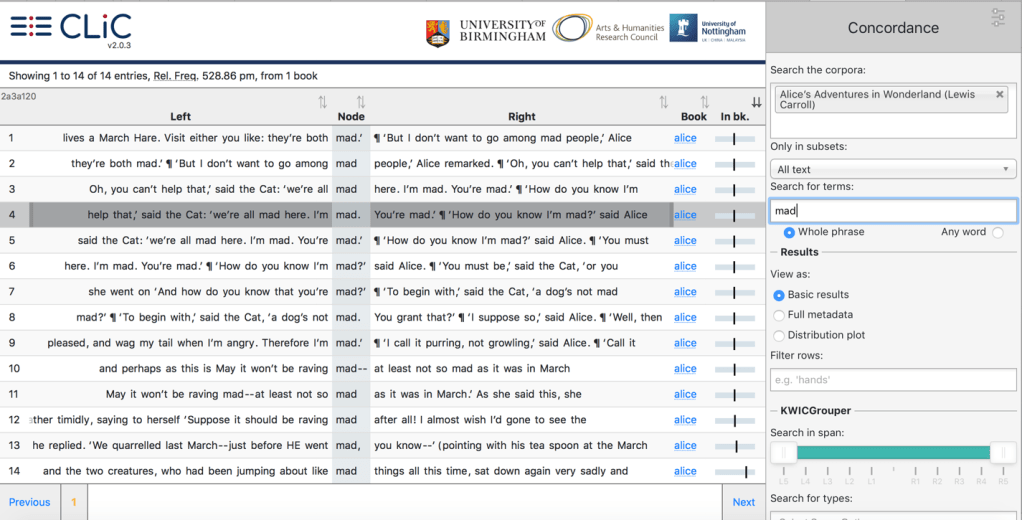
Finding the texts on CLiC (http://clic.bham.ac.uk/) was somewhat difficult as the tool does not have any of these books embedded into it. However, a nice trick we learnt in class was to access the Gutenberg library, a free online library where the texts could be found in full plain transcript. We could then upload the latter on the Voyant tool and finally let it do its wonders. Moreover, and in order to explore the CLiC tool, we decided to analyze “Alice in Wonderland” by Lewis Carroll. We went with this book in particular as it stages the “Heroes vs Monsters” theme with Alice being the Hero of the story and the Queen of Hearts being her main antagonist. The latter falls in the imagination of the former (mental confrontation) and is a “a blind fury” who always commands death sentences at the slightest offense. The heroine, Alice, appears looking like herself, only smaller than usual (“small” and “little”). The Queen seems to have a large head, and a short tempered character, but does not confront the heroine physically. The word “mad” (mentioned around 14 times in the text) is associated with mental illness which reflects the state of mind Alice found herself in.
When using CLiC, we frequently referred to the concordanceand Keywords feature. In all subsets, we selected the all textoptions. The reference corpora were ChiLit or Childen’s Literature. Then, in order to answer the first question, we searched for the words “little” and “mad”. Regarding the second question, we entered the names Alice and The Queen and found their frequency of appearance in the text and the situations or context in which both are pictured.
Voyant
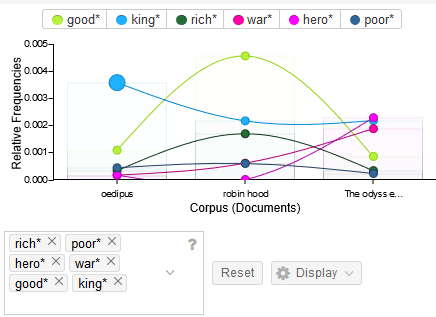
Moving on to Voyant, we began by observing the Cirrus cloud displaying the words which appear the most in the text. We we paralleled both texts in one corpus, the exact same words stand out as the most frequently used according to Cirrus. The cloud showed that the most frequent words are “Ulysses” (239 times), “Oedipus” (267 times), “Hero” (177 times), “Good (548 times), “Love” (104 times), “God” (318 times), “King” (473 times), “War” (213 times) and “Monster” (11 times), “Fight” (28 times), “Rich” (219 times), “Poor” (91 times), “Villain” (14 times), “Money” (97 times). In addition, we did not change the stop words options in the cloud since we did not see any words such as “the”, “and” or “for” that scrambled the results of the Cirrus search. Additionally, the summary tool did not contribute much since it generated similar results as those of the cloud in the category distinctive words. In the trends categories, we employed the graph of the frequency of each word throughout the texts.
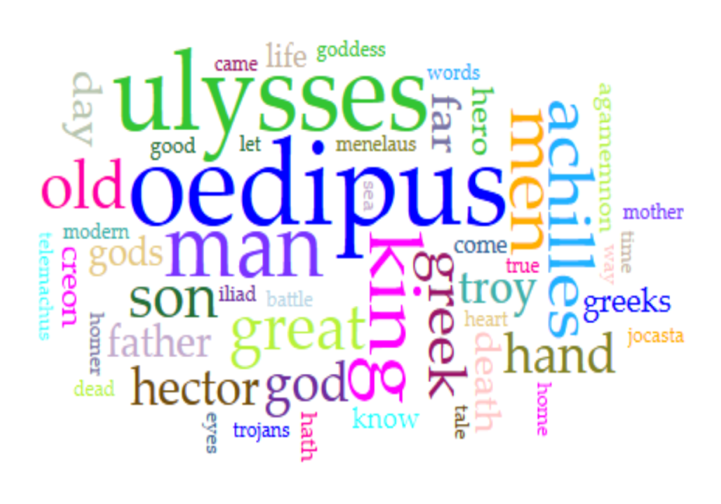
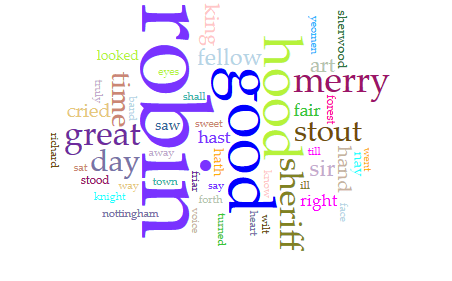
Each tool has helped in answering the team’s research questions. The cloud began by giving us a sense of which words appeared the most in the text. The phrases category shed light on significant sentences presented through each text and the corpus as a whole. Likewise, the trends graphs allowed us to view the trend of words over time: Word trends show how the work/theme has evolved and how writers started (or stopped) using specific words. Therefore, this feature helped us analyze the frequency of a given word throughout time (8th century BCE to 5th century BCE) and its utilization through the corpus. Thus, the trends were a clearer way to analyze the word count since it shows the variation in frequency of a single word depending on the segment of the corpus.
Concerning The Odyssey, we began by distant reading the text through Voyant. Then we moved to reading a few chapters of the book and detected why some words such as “Ulysses”, “Love” and “Hero” appear so often. Though, most of the ideas we understood then directly relate to the main objective of the text which had been already stablished from distant read. The same tactic was employed with Oedipus Rex and Robin Hood.
Results
The “The Story of Robin Hood and His Merrie Men” is written in a different era of literature than the other two.
Compared to the “The Odyssey” and “Oedipus Rex”, the hero in the story of Robin Hood is displayed differently and has a different purpose in the storyline. In “The Odyssey”, the hero had to prove himself and show-off his physical strength by going on a challenging adventure and battling monstrous creatures. In “Oedipus Rex”, the king who is also the hero of the story, struggles from a mental battle that has fated to kill his father and marry his mother, a different kind of war that the one Ulysses combats.
In Robin Hood, at that moment of time, the idea of a hero had been changed. Robin Hood is considered a “Hero”, not for his physical appearance or strength, nor for his role as a king, but because of his courage in the “Rich”. He works hard at defending the lower-class matter and working for the good of others.
Feedback on CLiC and Voyant
CLiC and Voyant are both online tools used for gaining an in-depth understanding of uploaded texts. They can be used for literary texts to gain new insights into how readers perceive characters and stories, however, each one has its own unique experience associated with the pros and cons.
Voyant is one of the tools that grant the best outcomes at ease. It allows researchers to understand huge collections of documents that are large for close-reading. Using it was very straightforward and user-friendly, evidenced through its ability to export data, extensive documentation, and simple user interface. First, the Voyant documentation website (http://docs.voyant-tools.org/) contains an explanation of resources for those seeking information. Tutorials are available for screencasts, screenshots, and using texts to make things easier for us as users. The simple interface is another user-friendly feature of Voyant, it is exhibited in the panels on the data analysis dashboard as well as the single data-entry field. The aforementioned panels have different text analysis tools that can be configured according to user preference. In addition to that, Word trends and frequencies can be examined, allowing the user to gain statistical information. Complementing Voyant’s user-friendliness is its ability to export data. Users have the choice of creating a link to retrieve the complete dashboard and corpus they’re analyzing at a later time so that no data will be lost. Also, Voyant is compatible with a wide range of document formats like HTML and plain texts, and it is easy to play around with tools simultaneously. Some limitations of Voyant Tools include the occasional prolonged text-loading time because its software is still in beta mode or sometimes gets stuck loading.
However, CLiC allows users to explore books and novels, mainly from the 19th century which makes it a bit outdated. It lets users search for particular words and phrases, study them in context, see how they are distributed across texts, and compare different texts with one another lacking any kind of visualization and the required analysis for the user. Voyant offers much more in terms of information analysis and utilization. Some added features suggested for CLiC include more analysis functions to assist the user and some visualization tools like tables and charts.
The main difference between distant reading and close reading first lies in the number of books read. Using CLiC and Voyant tools will get the work done in the fastest and most structured way possible when close reading might take forever. Another advantage of using these tools is objectivity, there are no emotions involved in the analysis, which might not be the case in close reading where every pupil analyzes a text with a different opinion. Another advantage of these tools includes allowing the user to find word frequencies, study word usage, and analyze the tone of the characters. Distant reading operates as a more scientific addition to the normal reading. However, sometimes distant reading is considered to impose a threat to what has been the core value of the (literary) humanities because it’s removing the human one step from the reading and turns literature into data and, in doing so, strips it of what distinguishes it.
Group 3 : Joseph Abboud, Alexia El Alam, Ghida Allam
 Joseph's Blog